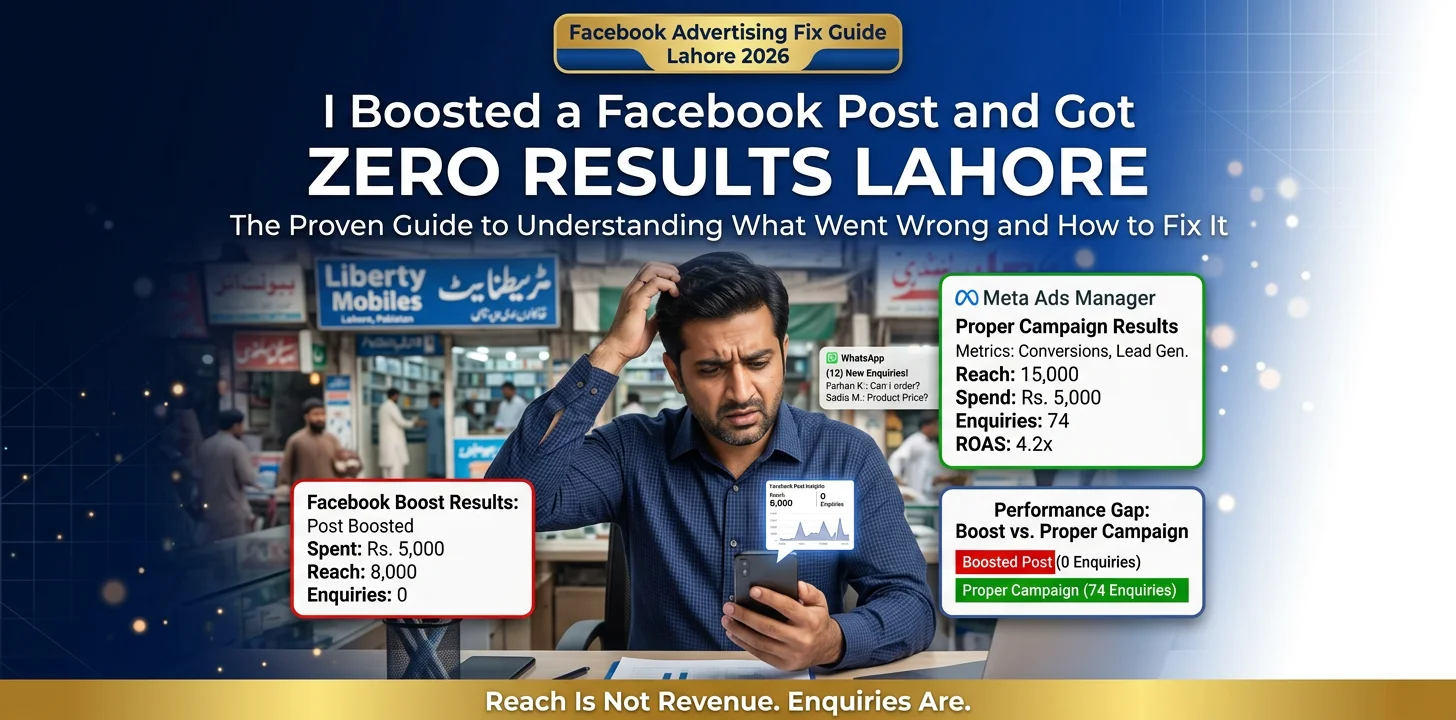
In this guide
- Facebook ad costs in Pakistan vary heavily by category, competition, and campaign objective, not just a single national average.
- Cost per click is the wrong metric to obsess over; cost per qualified lead is what actually matters for your business.
- A small test budget (a few thousand rupees a day) is usually enough to learn whether a campaign can work before committing bigger spend.
- Poor landing pages and weak creative waste far more budget than "high" CPMs ever do.
Anyone searching for a single number for "Facebook ads cost in Pakistan" is going to be disappointed, because there genuinely isn't one. A real estate developer targeting overseas Pakistanis pays a completely different rate than a local bakery targeting people within five kilometres. Both are "Facebook ads in Pakistan," but the economics are nothing alike.
Why There Is No Single "Average" Cost
Meta's ad auction prices placements based on competition for that specific audience, at that specific time, for that specific objective. A business targeting a broad Pakistani audience with a simple awareness objective will see a very different cost per click than one targeting a narrow, high-income urban audience with a lead-generation objective during a competitive period like Ramadan or Eid shopping season.
Rough Cost Ranges by Objective
As a general guide for the Pakistani market in 2026, cost per click for a broad, simple traffic campaign commonly falls somewhere in the PKR 5 to 20 range. Lead-generation campaigns, which ask more of the user (filling a form), typically carry a higher cost per result, often PKR 50 to 300 or more per lead depending on how qualified that lead needs to be and how competitive the category is. These are rough ranges, not guarantees, actual numbers shift constantly based on the auction.
What Actually Drives Cost Up
- Audience competition: Categories where many advertisers target the same audience (real estate, education, finance) tend to cost more per result.
- Campaign objective: Awareness and reach objectives are cheapest per impression; conversion and lead objectives cost more because Meta optimises for a harder outcome.
- Audience size and specificity: Very narrow audiences (a specific city, specific income bracket, specific interest combination) often cost more per result because there are fewer people to show ads to.
- Creative quality and relevance: Ads people actually stop scrolling for get rewarded with lower costs by Meta's algorithm. Weak, generic creative gets penalised with higher costs over time.
- Time of year: Costs rise noticeably during Ramadan, Eid, and other high-competition shopping periods when every retailer is bidding for the same attention.
Why Cost Per Click Is the Wrong Number to Focus On
A campaign with a low cost per click but a poor landing page and weak offer can still produce an expensive cost per actual customer, because most of those cheap clicks never convert into anything. A campaign with a higher cost per click but a strong offer, fast-loading landing page, and clear call to action can produce a cheaper cost per customer overall. The number that actually matters for your business is cost per qualified lead, or better still, cost per paying customer, not the click price in isolation.
What a Reasonable Test Budget Looks Like
You do not need a huge budget to learn whether Facebook ads can work for your business. A test budget of roughly PKR 3,000 to 5,000 a day, run for one to two weeks, is usually enough to gather meaningful data on which audiences and creative combinations perform, before deciding whether to scale spend up. Spending less than that for a shorter period rarely generates enough data for the algorithm to properly optimise.
Where Businesses Commonly Waste Budget
The two biggest budget-wasters are not actually "high" ad costs, they are a landing page that loads slowly or asks for too much information up front, and creative that looks like an obvious ad rather than something worth stopping for in a scrolling feed. Fixing either of those two things typically improves results more than any amount of audience targeting tweaking.
Comparing Categories Honestly
Real estate and overseas-investor targeting tend to run on the higher end of cost per lead, given the value of a single sale and the competition for that audience. Local services (clinics, salons, restaurants, retail) tend to see lower cost per lead, since the audience is broader and less competitively bid on. Education and B2B services often sit somewhere in between, with cost per lead depending heavily on how specific the targeting needs to be.
Getting a Realistic Number for Your Specific Business

Industry averages are a useful starting reference, but the only way to know your actual cost per lead is to run a real test campaign in your specific category, in your specific target area, with your specific offer. Published averages from other businesses, even similar ones, can only ever be a rough guide.
Brand Builders helps businesses across Pakistan with Meta Ads management. To get started, book a strategy session with our team or get in touch directly.
Book your free strategy sessionFrequently Asked Questions
01What is a typical cost per click for Facebook ads in Pakistan?
Roughly PKR 5 to 20 for a broad traffic campaign, though this varies by audience, competition, and time of year.
02What is a typical cost per lead on Facebook ads in Pakistan?
Often somewhere between PKR 50 and 300 or more, depending on how qualified the lead needs to be and how competitive the category is.
03Why do Facebook ad costs go up during Ramadan and Eid?
More advertisers compete for the same audience attention during these high-shopping periods, which raises auction prices across the board.
04Should I focus on cost per click or cost per lead?
Cost per lead (or ideally cost per paying customer) matters far more, since a cheap click that never converts is actually more expensive than a costlier click that does.
05How much budget do I need to test if Facebook ads will work for my business?
Roughly PKR 3,000 to 5,000 a day for one to two weeks is usually enough to gather meaningful data before deciding whether to scale spend.