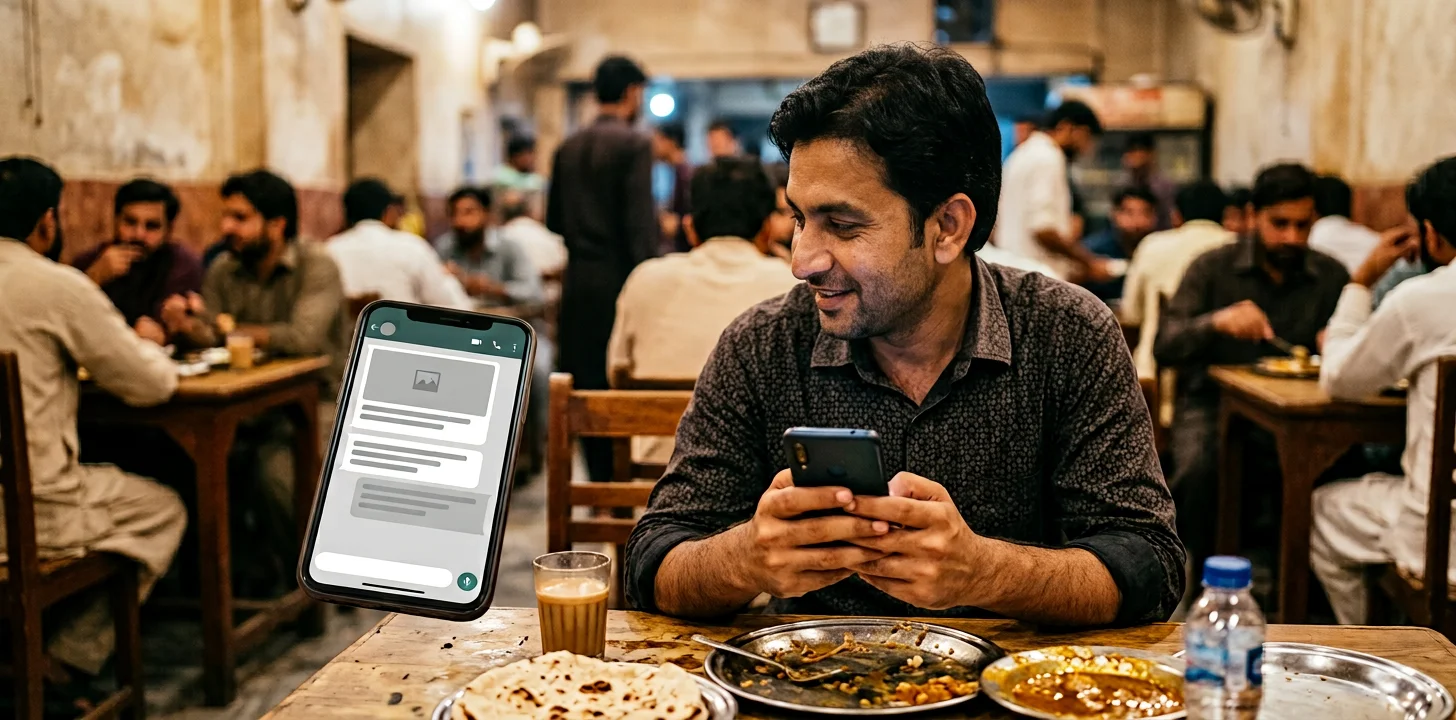
WhatsApp is not a secondary channel for Pakistani restaurants. For most restaurants in Lahore, Karachi and Islamabad, it is the primary channel through which customers actually place orders, ask questions and decide whether to come back. WhatsApp marketing for restaurants in Pakistan consistently outperforms email, and frequently outperforms social media, because it is where customers already are and it requires no app switching to act.
This guide covers exactly how restaurants use WhatsApp for orders, promotion and retention, and what separates the restaurants using it effectively from those simply posting a number on their menu.
Why WhatsApp Works Better Than Almost Anything Else
It is where Pakistani customers already are. WhatsApp penetration in Pakistan is extremely high, and it is the default communication channel for a large proportion of the population, cutting across age groups and income levels in a way few other platforms do.
It removes friction from ordering. A customer deciding what to eat does not want to download an app, create an account and enter payment details. They want to send a message and have someone reply. WhatsApp meets that expectation directly.
Read rates are extremely high. Messages on WhatsApp are opened at a rate that email marketing cannot approach, and they are typically opened quickly rather than sitting unread for days.
It supports rich content. Menus, photos, location pins and voice notes can all be shared within the same conversation, which means a full ordering and enquiry experience can happen without leaving the app.
It builds a direct relationship. Unlike a social media follower, a WhatsApp contact is a direct line to a specific customer that the restaurant owns and controls, not one mediated by a platform algorithm.
Setting Up WhatsApp Business Properly
Use WhatsApp Business, not a personal account. The business version provides a catalogue feature, automated greeting and away messages, quick replies for common questions, and basic analytics, none of which exist on the personal app.
Complete the business profile fully. Address, hours, website and a clear description. Many restaurants set this up once and never revisit it, which means outdated hours or an old address sit there quietly costing orders.
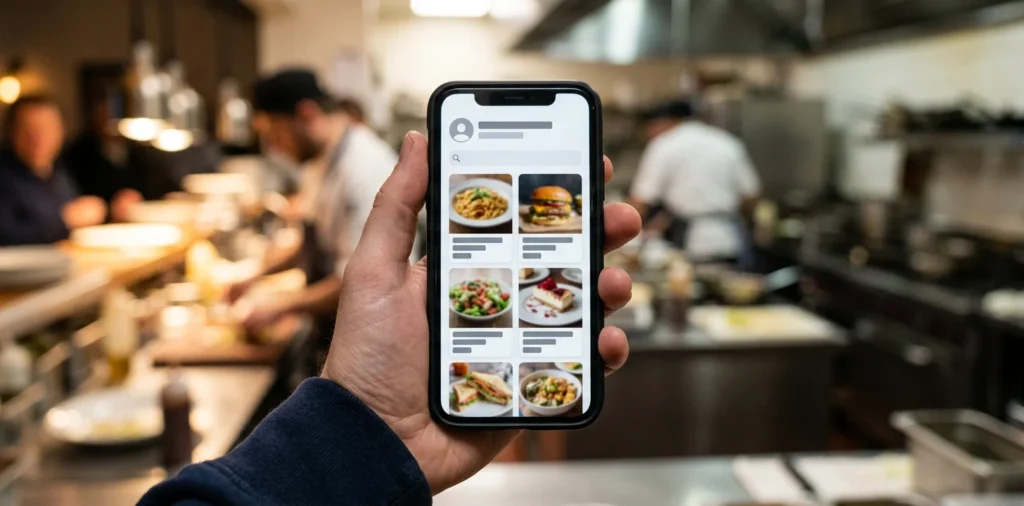
Build a catalogue. The catalogue feature allows customers to browse menu items with photos and prices directly within WhatsApp, which considerably reduces the back and forth of a customer asking what is available.
Set up quick replies for common questions. Delivery area, minimum order value, payment methods and current offers all get asked repeatedly. Quick replies let staff answer instantly rather than typing the same response dozens of times a day.
Configure an away message for closed hours. A customer messaging outside opening hours should get an immediate response confirming when the restaurant reopens, rather than silence that leaves them uncertain whether the message was received at all.
Using WhatsApp for Orders
Make the ordering flow as short as possible. The fewer messages required to place an order, the higher the completion rate. A well-structured catalogue combined with a simple confirmation process reduces order friction significantly compared to a free-form back and forth conversation.
Confirm every order clearly. A message confirming exactly what was ordered, the total cost, and expected delivery or collection time reduces disputes and builds confidence for the next order.
Respond fast, especially during peak hours. A customer ordering food is ordering because they are hungry now. A slow response loses the order to whichever restaurant replies first, in exactly the same way a slow response loses any time-sensitive enquiry.
Use WhatsApp for order status updates. A message confirming the order is being prepared, and another when it is out for delivery, reduces the anxious repeat messaging that otherwise ties up staff time and improves the customer experience simultaneously.
Keep a record of customer preferences where relevant. Regular customers who always order the same thing, or who have noted a specific request, appreciate not having to repeat themselves every time.
Using WhatsApp for Marketing
This is where many restaurants either overuse the channel and generate opt-outs, or underuse it and miss genuine opportunity. The balance matters.
Build the list through natural touchpoints. Every completed order is an opportunity to ask if the customer wants to be added to a list for offers and updates, rather than running a separate acquisition campaign.
Segment by behaviour where possible. Customers who order frequently deserve different messaging from those who ordered once and never returned. Broadcasting the same message to everyone equally wastes the platform’s targeting potential.
Send genuinely useful content, not just promotions. A new menu item, a limited availability dish, or an event at the restaurant gives customers a reason to open the message beyond a generic discount. Pure discount-only messaging trains customers to only respond to discounts.
Respect frequency. Messaging too often is the fastest way to generate opt-outs on WhatsApp specifically, because it sits in the same inbox as personal conversations and feels more intrusive than an email that can be ignored in a separate folder. Once or twice a week is a reasonable ceiling for most restaurants.
Use broadcast lists correctly. WhatsApp broadcast lists send individual messages that appear as a normal one-to-one conversation to the recipient, rather than a visible group. This preserves the personal feel that makes WhatsApp effective in the first place.
Automating WhatsApp Without Losing the Personal Feel
As order volume grows, fully manual WhatsApp management becomes unsustainable, particularly during peak hours when staff are also managing the kitchen and dining room.
Automated first response. An immediate acknowledgement when a message arrives outside the time staff can respond instantly, confirming the message was received and giving an expected response time.
Automated order confirmations. Once an order is logged, an automatic confirmation with the order details removes a manual step and reduces errors from staff typing under pressure.
Automated reminder and reactivation messages. Customers who have not ordered in a while can be reached with an automated, appropriately spaced message rather than relying on staff to remember to reach out.
Human handoff for anything unusual. Automation should handle the routine volume and hand off complaints, special requests or anything outside the standard flow to a person immediately. Automation replacing genuine service entirely produces a worse experience, not a better one.
Our content creation and social media services help restaurant clients build and manage WhatsApp catalogues and messaging systems, and our social media marketing service covers the wider content strategy that feeds customers toward WhatsApp in the first place.
What Restaurants Get Wrong
Using a personal number instead of WhatsApp Business. Loses the catalogue, automation and analytics features entirely, and looks less professional.
Slow response during peak hours. The exact hours when order volume is highest are the hours a slow response costs the most revenue.
Discount-only messaging. Trains customers to wait for offers rather than ordering at full price, and erodes margin over time.
No opt-out respected. Customers who ask to stop receiving messages and continue receiving them generate complaints and damage the restaurant’s reputation on the one channel where trust matters most.
Inconsistent tone between staff members. If several people respond to WhatsApp messages, inconsistent tone and information create a confusing customer experience. A shared set of quick replies and guidelines keeps this consistent.
Brand Builders helps businesses across Pakistan with social media management. To get started, book a strategy session with our team or get in touch directly.
Book your free strategy sessionFrequently Asked Questions
01Is WhatsApp better than social media for restaurant marketing in Pakistan?
They serve different purposes. Social media builds awareness and reaches new customers who are not yet connected to the restaurant. WhatsApp converts and retains customers who already know about it, typically with considerably higher response and order completion rates than any other channel.
02Should restaurants use WhatsApp Business or a personal account?
WhatsApp Business, without exception for any restaurant serious about the channel. It provides the catalogue, automation, quick replies and basic analytics that a personal account does not offer, at no additional cost.
03How often should a restaurant send WhatsApp marketing messages?
Once or twice a week is a reasonable ceiling for most restaurants. More frequent messaging tends to generate opt-outs, since WhatsApp sits in the same inbox as personal conversations and feels more intrusive than other channels when overused.
04Can WhatsApp handle a restaurant’s full order volume?
For most independent and mid-size restaurants, yes, particularly with automation handling confirmations and status updates. Very high-volume operations may need dedicated ordering infrastructure alongside WhatsApp, but for the large majority of restaurants in Pakistan, WhatsApp alone is sufficient.
05How do I build a WhatsApp customer list for my restaurant?
Ask every customer at the point of ordering whether they want to be added for offers and updates, rather than running a separate acquisition campaign. This produces a list of people who are already customers and genuinely interested, which converts considerably better than a cold list.