
In this guide
- A no show is a booked slot the patient does not use and does not cancel, so nobody else can take it.
- A systematic review of 26 studies found that notifications cut no shows by about a quarter, and several messages beat one.
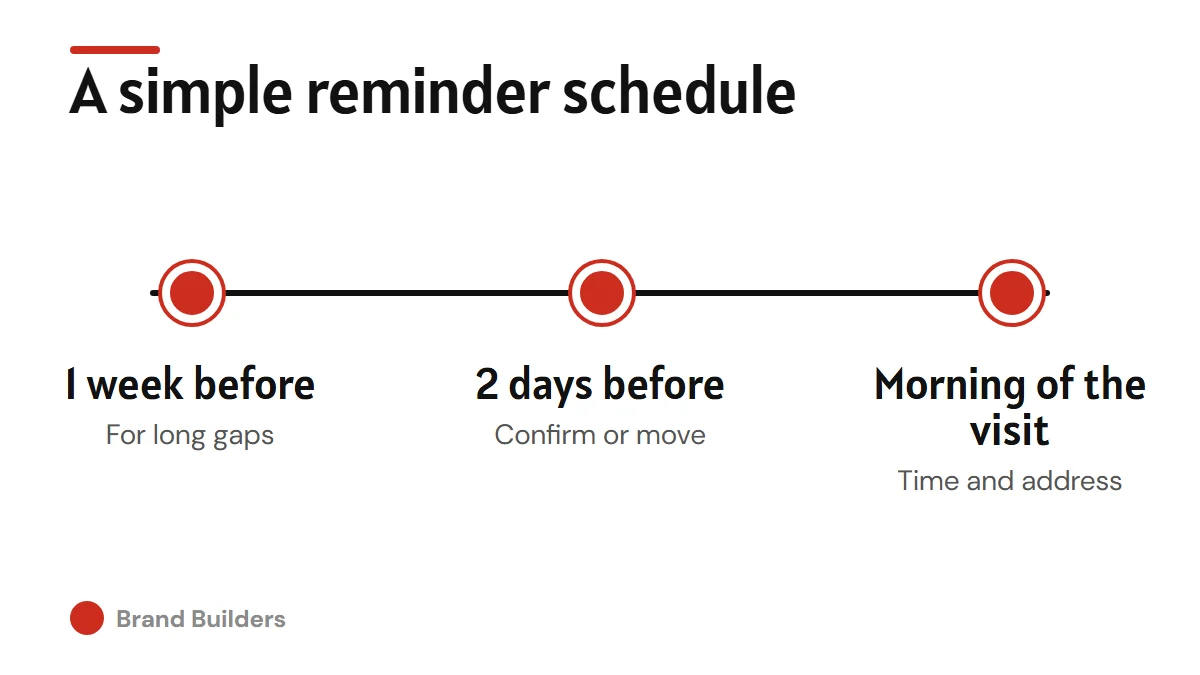
- Send two or three messages: two days before, the morning of the visit and, for long gaps, a week before.
- Make it easy to reply, cancel or move the booking, and keep a waiting list to fill freed slots.
- Count your no show rate before and after. Do not trust a feeling.
Quick answer: Appointment reminders for clinics reduce no shows. A 2016 systematic review in BMJ Open found that patients who got text notifications were 25 percent less likely to miss an appointment, and that more than one message worked better than one. A simple schedule is one message two days before, one on the morning of the visit and an easy way to confirm, cancel or move the booking.
Every empty slot in a clinic day is lost time for the doctor and a lost chance for another patient. Reminders are one of the cheapest ways to protect those slots. This guide shows what the research says, how to set up reminders on WhatsApp or SMS, what to write and how to measure the result. We help Pakistani clinics with WhatsApp and patient communication, so the examples below are practical and easy to copy.
Set up reminders for your clinic
Why do no shows hurt a clinic?
The BMJ Open review explains the problem simply. Missing an appointment without cancelling in advance creates a vacant slot that cannot be offered to anyone else. The doctor, the room and the staff are still there, but the patient is not.
For a private clinic in Lahore, Karachi or Islamabad, that is lost income and a longer wait for the next patient. It also affects the patient who missed the visit, because delayed care can mean a longer treatment later. Marketing can bring new patients, but if a share of them do not arrive, the marketing money is wasted. That is why reminders sit next to patient retention as a core part of clinic growth.
What does the research say about appointment reminders for clinics?
The strongest source we found is a systematic review and meta analysis published in BMJ Open in October 2016. It looked at studies of text based electronic notifications and how they affected attendance at prescheduled healthcare appointments. Its main points:
those who received notifications were 25 percent less likely to no show, with a risk ratio of 0.75, which in the studies meant about 15 percent against 21 percent. Multiple notifications worked better than a single one. Voice notifications appeared more effective than text. The authors concluded that electronic text notifications improve attendance and reduce no shows across healthcare settings.
| Finding | Result in the review |
|---|---|
| Patients who got a notification | 25% less likely to no show (risk ratio 0.75) |
| No show rate in the studies | About 15% with notifications against 21% without |
| One message or several | Several messages worked significantly better |
| Text or voice | Voice appeared more effective than text |
Source: BMJ Open 2016, "Using digital notifications to improve attendance in clinic: systematic review and meta-analysis", opened 25 November 2026.
Be careful with the numbers. The studies come mostly from other countries and the review is ten years old. Your own result may be smaller or larger. The safe conclusion is that reminders help, and that you should measure the effect in your own clinic.
A reminder schedule you can copy
Start with a short schedule and adjust.
Two days before. The first message gives the patient time to plan, ask for another time or cancel. Include the doctor's name, the date, the time and the clinic address.
Morning of the visit. A short message with the time and the way to reach reception if something has changed.
One week before, for long gaps. If the booking was made weeks ago, add an early reminder, because people forget plans made far ahead.
Do not send more than three. Too many messages feel like pressure and can make patients ignore all of them. Choose the time of day with care: a message at 3 in the morning will not help anyone.
What should a reminder say?
Keep the words short, polite and plain. Here are three examples you can adapt. Replace the brackets with your details.
First message: "Assalam o Alaikum [Name]. This is a reminder of your appointment with Dr [Name] at [Clinic] on [Date] at [Time]. Please reply 1 to confirm or 2 to change the time."
Morning message: "Good morning [Name]. Your appointment at [Clinic] is today at [Time]. Our address is [Address]. If you cannot come, please reply 2 and we will find you another slot."
After a missed visit: "Assalam o Alaikum [Name]. We missed you today at [Clinic]. Reply to this message and we will help you book another time."
Write in the language your patients use, such as English, Urdu or Roman Urdu. Never put a diagnosis, test result or medicine name in an automatic message. Keep private details for the visit and for a direct, secure conversation.

Make it easy to confirm, cancel or move the booking
A reminder that cannot be answered is only half a tool. Ask for a one word reply and give a phone number for people who prefer to call. Treat a cancellation as good news. A patient who cancels two days before frees a slot that someone else can take.
Keep a waiting list of patients who want an earlier time. When a slot opens, message the first person on the list. Staff should know who is responsible for this each day, or the list will be forgotten.
WhatsApp, SMS or a phone call?
The review found that voice notifications appeared more effective than text, which fits what many reception teams know: a short, friendly call still works. Calls cost staff time, though, so most clinics use text for most patients and calls for important or high value appointments.
WhatsApp is where many Pakistani patients already read messages, and it makes replying easy. If you send reminders from the free WhatsApp Business app on a phone, you do it by hand or with simple tools. If a system sends them for you through the WhatsApp Business Platform, Meta now charges for each utility message such as a reminder. We explain the numbers in our guide to WhatsApp Business API pricing in Pakistan. SMS is a good back up for patients who do not use WhatsApp. Our post on WhatsApp marketing for clinics shows other ways to use the channel.
Talk to us about patient communication
Privacy and consent
Tell patients at booking that you will send reminders, and ask for the number they prefer. Use the patient's name and the clinic's name so the message is clearly yours. Keep the message free of medical details. Store phone numbers securely and give only the front desk access. If a patient asks you to stop, stop.
How to measure your no show rate
Count for one month before you start. Take the number of booked appointments and the number of patients who did not arrive and did not cancel. Divide the second by the first and multiply by 100.
For example, a clinic with 400 bookings and 60 no shows has a no show rate of 15 percent. After a month of reminders, count again. If the same clinic now has 400 bookings and 45 no shows, the rate is 11.25 percent. These numbers are examples, not a promise. Compare the same weeks and the same doctors so that holidays do not change the answer.
Also track how many slots you refilled from the waiting list. A fall in no shows plus refilled slots is the real gain.
A four week plan
Week 1: count your current no show rate and decide who owns reminders.
Week 2: write the three messages in your patients' language and test them on staff.
Week 3: start reminders for one doctor or one day of the week.
Week 4: compare the numbers, adjust the wording and roll out to the whole clinic.

Conclusion
Appointment reminders for clinics are a low cost way to protect your day. The best evidence we found says a short series of messages can cut no shows by about a quarter, though your own result will vary. Send two or three polite messages, make it easy to confirm or move the booking, keep a waiting list and count the result. Brand Builders in Johar Town, Lahore, helps clinics set up patient messaging that is clear and respectful. Book a free strategy session and we will map your reminder flow with you.
Brand Builders helps businesses across Pakistan with social media management. To get started, book a strategy session with our team or get in touch directly.
Book your free strategy sessionFrequently Asked Questions
01Do appointment reminders really reduce no shows?
A 2016 BMJ Open systematic review found that patients who received text notifications were 25 percent less likely to miss an appointment, about 15 percent against 21 percent in the studies. Most studies were outside Pakistan, so measure the result in your own clinic by counting no shows before and after.
02How many reminders should I send?
The review found that several notifications worked better than one. Two or three is a sensible limit for most clinics: two days before, the morning of the visit and, for bookings made far ahead, one more a week before. More than three can feel like pressure.
03Should reminders go by WhatsApp, SMS or phone?
Use the channel your patients read. WhatsApp suits many patients in Pakistan and makes replying easy. SMS is a back up for others. The review found voice notifications appeared more effective than text, so keep calls for important appointments if staff time allows.
04Can I put the reason for the visit in the message?
Keep it out. Automatic messages can be read by anyone who sees the phone. Use the patient's name, the doctor's name, the date, the time and the address, and leave diagnoses, results and medicines for the visit or a direct private conversation.
05How do I know if reminders are working?
Count your no show rate for a month before you start, then for a month after. Divide the patients who did not arrive and did not cancel by the total bookings. Also count the slots you refilled from the waiting list. Compare the same weeks.